
Introduction
In any company, we have a set of organized activities aimed at serving customers, purchasing goods, approving and processing supplier payments, handling warranties, and so on. We call this set of interrelated activities “processes,” and whether optimally or not, every company manages them one way or another. In this article, we’ll discuss how to implement BPM Process Management and how it helps optimize a company’s operational efficiency.
About BPM
As I mentioned earlier, every company manages processes in some form. What makes implementing BPM—or Business Process Management—special is the methodology itself. It provides a structured approach to process management that, when aligned with the company’s strategic objectives, translates directly into improved operational efficiency (1).
The Phases of BPM
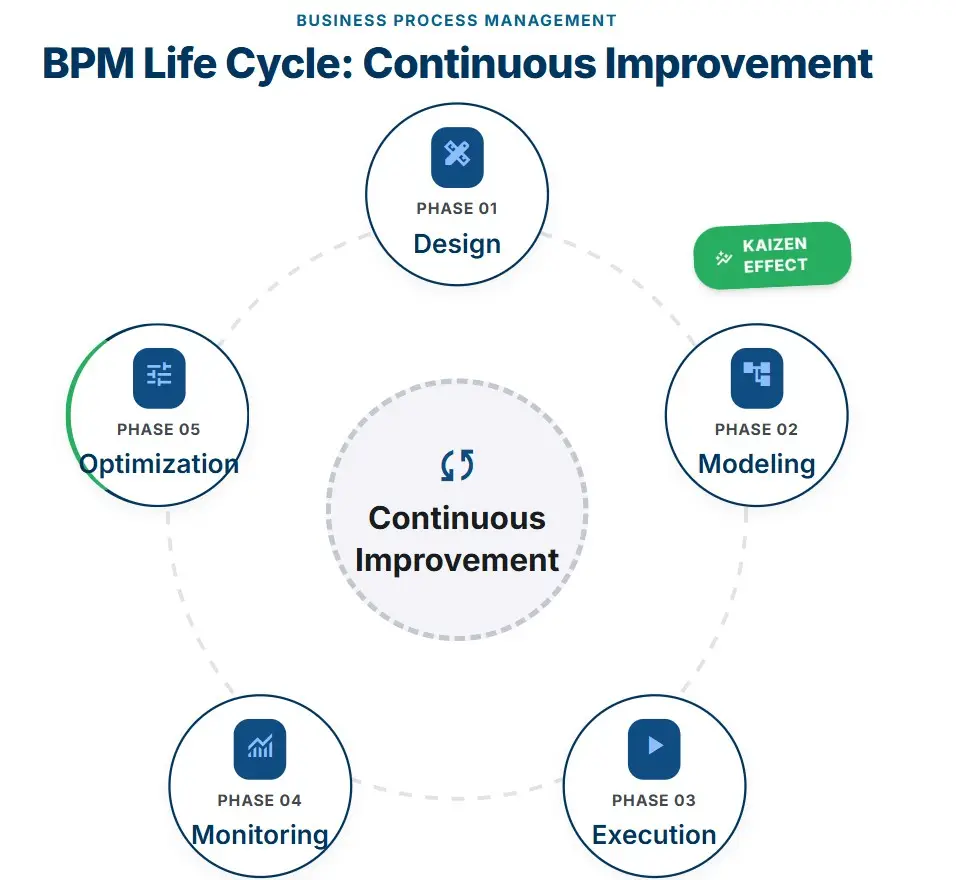
BPM, or Business Process Management, offers an organized way to manage processes through five phases. True to the Kaizen philosophy (continuous improvement), it ensures that every process within the BPM framework keeps evolving. Below, I describe each phase in order:
1. Design
Just as professional building construction requires blueprints, BPM demands that processes have clear plans or designs. This includes detailing what each process receives as input, what it delivers as output, who is involved, what information is handled, and what constraints exist.
Design allows you to see the full picture of the workflow you’re working on. This way, you can identify redundant processes, activities that aren’t worth implementing, personnel causing delays, and even points where your production quality degrades.
2. Modeling
Once a process is designed, we need to create a visual representation of it. This could be a form, an Excel sheet, a database table, or a screen within an application. Modeling lets you test before executing and correct errors proactively.
My advice? Test it against the most unlikely scenarios—the ones that break the system’s logic but could still happen. For example, a customer requesting credit for an undefined term that requires GM approval, or a supplier delivering an unusually large batch of orders just once. These edge cases often force you back to the drawing board.
3. Execution
This is about putting your model into action. If you designed system screens, it means launching the system into production. If you used paper forms (though I don’t recommend it), it means using those forms in the field. Simply put, it’s about real-world usage.
The success or failure of execution depends on the level of detail in your design and modeling, as well as your forecasting ability. The goal is to digitize the process 100% as much as technology and budget allow, since that is ultimately what BPM aims for—even if some purists won’t admit it outright.
You rarely apply BPM to something that isn’t going to be digitized.
4. Monitoring
This phase runs parallel to execution. It measures execution efficiency through KPIs and generates reports or dashboards, allowing supervisors to verify whether users are properly adopting the process, actually using it, and how this impacts the company.
5. Optimization
This phase also runs alongside monitoring and execution. It analyzes the data and KPIs generated during monitoring, along with complaints or incidents from execution, enabling real-time detection of failures and immediate proposals for improvements. These improvements can then be quickly redesigned, remodeled, and redeployed. This is the Kaizen effect I mentioned earlier.
BPM and Operational Efficiency in a Company
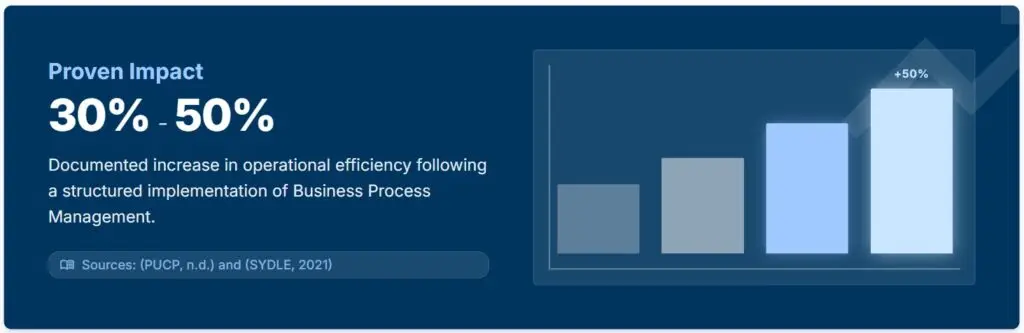
Many companies apply at least some form of Business Process Management empirically. However, formally mandating BPM significantly boosts operational efficiency by 30% to 50% across administrative and production processes (2). Other sources report similar figures for support operations (3). In short, companies that implement BPM see substantial gains. That said, there are critical factors to consider—some may seem obvious, yet many overlook them:
a) Involve insiders, not just consultants
People involved in process design shouldn’t be external consultants alone. You need active participation from staff who understand the full workflow, its importance within the organization, the competitive advantage of optimizing it, its financial impact, and its automation potential. In other words, every process design needs someone with internal experience, deep business knowledge, and genuine motivation to improve things.
b) Perfect is the enemy of good
Trying to achieve a perfect process—or set of processes—with an overly ambitious scope is often the death knell for BPM initiatives. For companies with zero optimization and chaotic process management, expecting BPM to make everything “flow smoothly” overnight is unrealistic unless they have exceptional resources. Successful organizations typically apply BPM gradually to key processes, embracing continuous improvement—in other words, taking it step by step.
c) Pair BPM with a serious digital transformation strategy
Many BPM articles treat “automation” as the final phase. But in today’s AI era, automation should be embedded in nearly every process. A true digital transformation strategy guides you to surgically select which processes to automate first—those that deliver visible short-term results and motivate the organization to keep improving.
d) Continuity matters, especially early on
For companies just maturing their BPM practices, leadership continuity is crucial. I’ve seen many BPM initiatives fail due to turnover among managers or department heads—a reality rarely discussed in BPM literature. Processes carry the imprint of those who design or champion them. A conservative leader might focus on backend efficiencies without touching customer experience, while a bolder one might digitize the entire journey. But if that key person leaves or changes roles, their successor may have a completely different vision—and scrap the entire design, halt execution, or demand new KPIs that were never part of the original plan.
Conclusions
While BPM is a widely adopted methodology, its purpose should always be the continuous improvement of operational efficiency—not the indiscriminate digitization or automation of everything in sight. Nor should it become a theoretical framework meant only to be “framed on the wall.” Instead, it must engage key stakeholders to take action and deliver tangible results across all its phases.
At Blionsoft, applying this methodology is always our first step—before recommending any specific software or tech development. Our goal isn’t to sell systems or applications; it’s to drive the continuous improvement of our clients’ business processes.
Sources
(1) https://www.ibm.com/mx-es/think/topics/business-process-management
(3) https://www.sydle.com/es/blog/que-significa-bpms-604f6e2c2dbf0411f26373ed